
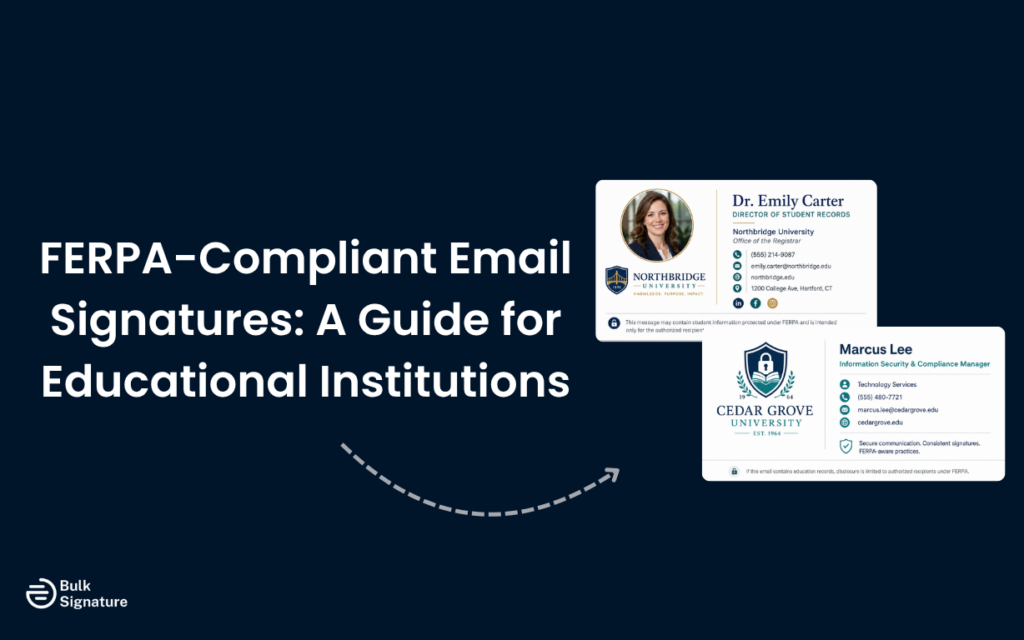
Educational institutions are more digital than ever. Student records, consent forms, and financial aid now almost exclusively move through email and online portals. And while that convenience saves a significant amount of time and resources, it also raises an important question: how do schools stay FERPA-compliant while communicating at scale?
The answer to that question lies in the small, routine communication habits schools build into everyday workflows. And a big piece of that puzzle is email signatures.
We know how serious student privacy and FERPA compliance are, so in this guide, we’re breaking down what FERPA-compliant email signatures involve, how electronic consent works, and the practical steps schools can take to protect student information while building trust with students and families.
Understanding the Family Educational Rights and Privacy Act
The Family Educational Rights and Privacy Act (FERPA) of 1974 is the foundational federal law governing the access to and disclosure of student records. Its primary goal is to give parents and eligible students control over their educational information while preventing unauthorized access by any outside party.
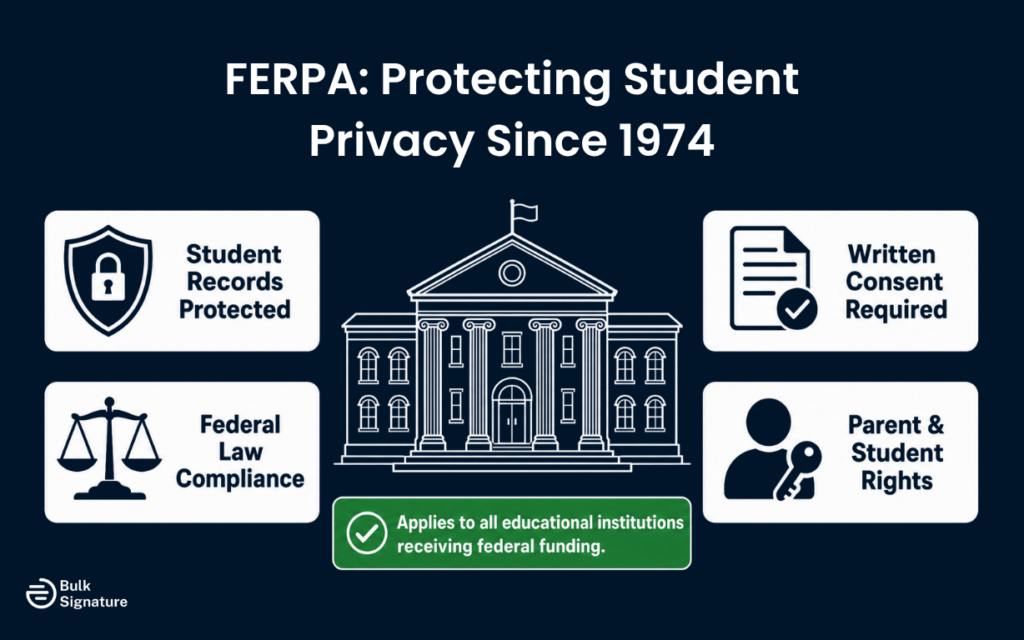
Under FERPA, an educational institution must obtain written consent from a parent or eligible student before disclosing any personally identifiable information from the student’s education records. This rule applies to all aspects of a student’s education record, including grades, financial aid information, and disciplinary records. There are exceptions, such as disclosing information to a school official with a legitimate educational interest or complying with a judicial order, but the general rule is that consent is always required.
As technology evolved, the methods for obtaining this consent evolved, too. In the early 2000s, the Department of Education formally clarified that FERPA consent requirements could be met electronically, leading to more specific guidance around electronic consent and digital signatures.
A Quick Guide to FERPA Consent Requirements
Before we go a bit deeper into electronic consent and email compliance, it helps to understand when written permission is actually required under FERPA. While the law generally protects student records from unauthorized disclosure, there are several exceptions that allow institutions to share information in specific circumstances.
The table below breaks down common scenarios schools encounter and whether written consent is required.
Common Student Record Requests and FERPA Exceptions
Scenario | Is Written Consent Required Under FERPA Regulations? | Exception Details |
Sharing grades with a student’s parents (if student is over 18 and not a tax dependent) | Yes | No exception applies; student must provide consent. |
Sharing academic records with another university where the student intends to enroll | No | Covered under the transfer exception. |
Releasing a student’s GPA to a potential employer | Yes | No exception applies; student must provide consent. |
Providing records to a financial aid provider to determine eligibility | No | Covered under the financial aid exception. |
Disclosing directory information (if the student has not opted out) | No | Covered under the directory information exception. |
The Shift to Electronic Consent and Digital Signatures
In the past, obtaining written consent meant requiring a physical signature on a paper document. Today, educational institutions rely heavily on electronic forms and e-signatures to streamline processes and improve efficiency. However, not all electronic signatures are equal in the eyes of the law.
To address this, the Department of Education clarified that signed and dated written consent can exist in electronic form, as long as specific requirements are met. In simple terms, schools must be able to reasonably verify who is providing consent and clearly document what they are approving. The goal is to make electronic consent just as trustworthy and legally valid as a handwritten signature.
That means typing a name at the bottom of an email usually is not enough. Schools need reliable ways to confirm identity, such as secure student portals, login credentials, PINs, or multi-factor authentication.
The Importance of Audit Trails
Collecting electronic consent is only one part of the story. Institutions also need a reliable way to prove that consent was obtained correctly if any questions arise later.
This is where audit trails enter the equation. A strong audit trail documents when a signature was completed, which document was signed, and the method used to verify identity. In many cases, institutions also log information like timestamps, devices, or IP addresses to create a clear record of the transaction.
If a student record disclosure is ever questioned, that documentation becomes critical. Schools may need to demonstrate that they obtained valid, dated consent and followed FERPA requirements before sharing protected information.
Implementing FERPA-Compliant Email Signatures
While the FERPA final regulations primarily focus on electronic consent forms, the principles of FERPA compliance extend to all digital communications, including email. When a school official sends an email that contains or discusses student records, they must guarantee that the communication is secure and that the recipient is authorized to receive the information.
Here are some practical ways schools and universities can strengthen FERPA compliance through more secure, consistent email practices.
Keeping Student Data Safe
Email is inherently vulnerable to interception and unauthorized access. That means educational institutions should avoid sending personally identifiable information via standard, unencrypted email whenever possible. Instead, they should use secure portals or encrypted email services to share sensitive data.
If an email must contain student information, the sender must verify the recipient’s identity. For example, if a student emails a professor to request their grades, the professor should only reply to the student’s official university email address, not a personal email account. This helps confirm that the disclosure meets FERPA requirements.
The Role of the Email Signature Block
The email signature block itself plays a massive role in compliance. A professional email signature should clearly identify the sender’s name, title, and department. It should also include a confidentiality notice or legal disclaimer stating that the email may contain protected information and is intended only for the designated recipient.
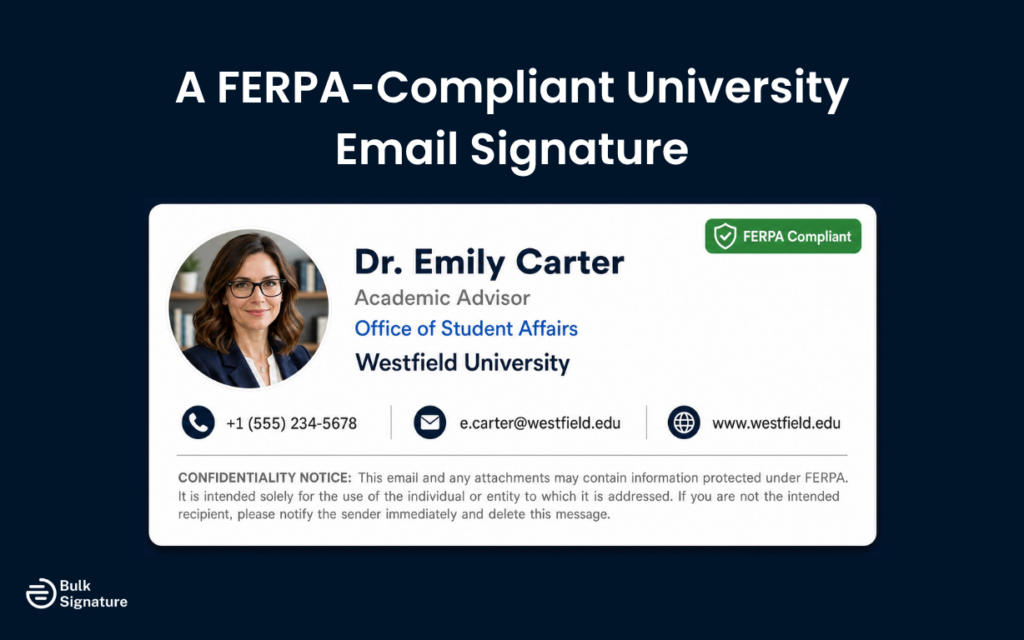
While a disclaimer doesn’t absolve an institution of liability if a breach occurs, it still serves as a necessary warning to recipients and demonstrates that the institution is taking steps to protect student privacy.
Standardizing Email Signatures Across the Institution
To guarantee consistency and compliance, educational institutions should never leave email signature design up to individual employees. Instead, they should implement a centralized email signature management system.
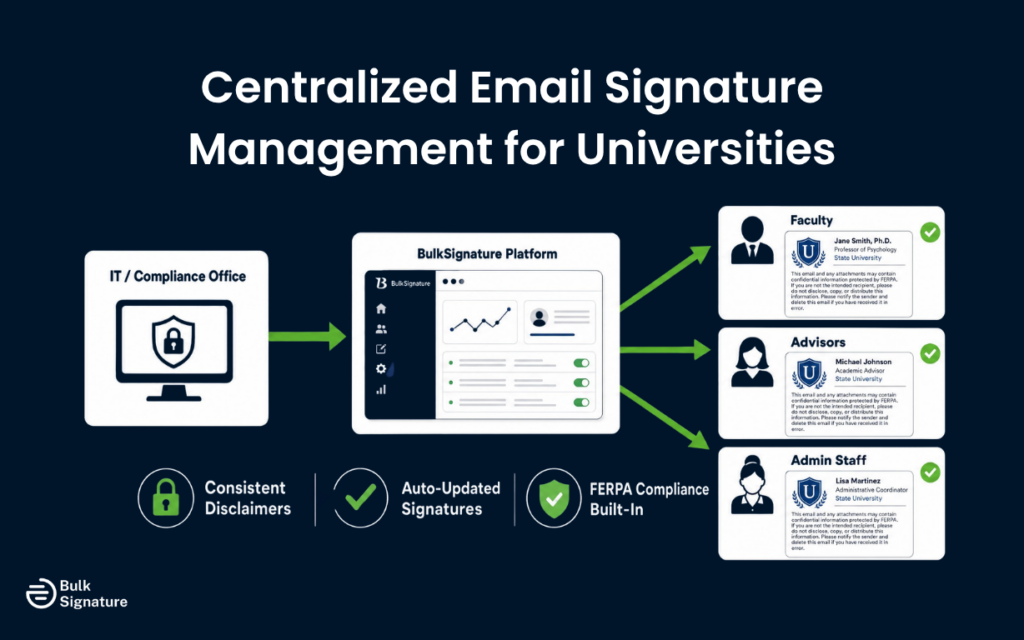
A centralized email signature management platform, like BulkSignature, allows the IT department or compliance office to create standardized email signature templates that include the necessary legal disclaimers and accurate contact information. When a new academic year begins, the system can automatically update signatures across the entire organization, guaranteeing that every email sent by a school official meets the institution’s compliance requirements. This eliminates the risk of employees using outdated or non-compliant signatures.
More on professional email signatures for colleges and universities here: How to Make a Professional Email Signature for School.
Managing Directory Information
One area where FERPA compliance often causes confusion is the handling of directory information.
Under FERPA, directory information refers to details that generally are not considered harmful if disclosed, such as a student’s name, email address, phone number, mailing address, or major field of study.
Educational institutions may share this information without written consent, but only if they first notify students and parents about what qualifies as directory information and provide an opportunity to opt out.
That opt-out process becomes especially important in digital systems. When managing email directories, student portals, or campus address books, schools need to respect student privacy preferences. If a student chooses to withhold their directory information, their email address and contact details should not appear in public directories or searchable campus systems.
Even small configuration mistakes can create compliance risks, which is why regularly reviewing directory settings and access permissions is an important part of FERPA compliance.
The Intersection of Directory Information and Third-Party Services
Schools and universities also need to be very careful when sharing directory information with third-party vendors. Even if certain student information can legally be disclosed under FERPA, institutions are still responsible for how that information is handled once it leaves their systems.
For example, vendors that support email, student portals, learning platforms, or administrative tools should only use student information for the specific purpose outlined in their agreement, meaning data should never be sold, reused, or shared with outside parties without authorization.
This is why strong vendor agreements are essential. Educational institutions should include clear data protection requirements in contracts, outlining exactly how student information can be used and requiring vendors to follow FERPA standards. Regular reviews of vendor access and security practices can also help reduce compliance risks over time.
3 Best Practices for FERPA-Compliant Email Communication
Protecting student information often comes down to the systems and communication habits institutions build into daily workflows, especially email. Secure communication, consistent signatures, and clear policies can significantly reduce compliance risks over time.
Here are four best practices higher education institutions should keep in mind as they strengthen FERPA compliance.
#1: Conduct Regular Audits
FERPA-compliant email communication is not something schools can set up once and forget about. Email systems, staff responsibilities, and communication habits change over time, which is why regular audits are so important.
Schools should periodically review how student information is shared through email, how electronic consent is collected and stored, and whether staff are following secure communication practices. It is also important to review email signature templates, disclaimers, and sending workflows to identify situations where sensitive student information could accidentally be shared with the wrong person or through an insecure channel.
#2: Provide Ongoing Staff Training
Even the best email security systems rely on people using them correctly. Teachers, advisors, administrators, and support staff all communicate with students differently, which means everyone needs a clear understanding of how FERPA applies to email communication.
Regular training can help staff recognize privacy risks, understand when consent is required before sharing information, use secure communication tools properly, and follow approved email signature and disclosure practices. Even small misunderstandings, like sending information to a personal email address or using an outdated signature, can create unnecessary compliance risks.
#3: Set Clear Expectations for Third-Party Vendors
Most colleges and universities rely on third-party vendors for tools that power everyday communication, including email hosting, student portals, learning management systems, and administrative software. But when those vendors have access to student information, the responsibility for protecting that data still falls on the institution.
That is why schools need clear expectations around how vendors handle student records and email-related data. Contracts should define how student information can be used, who can access it, and what security standards vendors must follow, especially for systems tied to email communication and student messaging.
It is also a good idea to regularly review vendor privacy and security practices over time. Technology changes quickly, and periodic check-ins can help schools spot risks early and maintain stronger FERPA compliance as communication systems evolve.
#4: Centralize Email Signature Management
Email signatures may seem like a small detail, but they play an important role in FERPA-compliant communication.
That’s why many colleges and universities have made the move toward centralized email signature management. This allows them to create approved templates that automatically apply consistent branding, staff details, and FERPA-related disclaimers across the institution.

At BulkSignature, we are dedicated to helping schools manage FERPA-compliant email signatures securely without introducing additional privacy concerns. We only use approved staff directory information, we never store or access student records, and we proudly help institutions maintain centralized control over branding and FERPA-related disclaimers.
Curious about what centralized email signature management could look like at your institution? Start a free trial or book a demo with us today and see how we help colleges and universities create more secure, consistent, and FERPA-compliant email communication at scale.
Frequently Asked Questions About FERPA-Compliant Email Signatures
Can schools share student records over email?
Schools can share student records through email in certain situations, but they must follow FERPA requirements carefully. Sensitive student information should only be shared with authorized recipients, and institutions should avoid using standard, unencrypted email whenever possible. Many schools rely on secure portals or encrypted systems for more sensitive communication.
What makes an electronic signature FERPA-compliant?
FERPA-compliant electronic signatures require clear identity verification and documented consent. In other words, institutions must be able to reasonably verify identity and clearly document approval before sharing student information.
In practice, this often means using secure student portals, login credentials, multi-factor authentication, or a personal identification number (PIN) to confirm that the right person is authorizing the request.
What happens if a school violates FERPA?
FERPA violations can lead to serious consequences for educational institutions. Schools may face investigations, corrective action requirements, and reputational damage if student privacy is mishandled. Repeated compliance failures can also place federal funding at risk, which is why strong communication practices, secure email workflows, and consistent policies are so important.


