
Every day, your team sends hundreds, sometimes thousands, of emails. And at the bottom of every single one of those emails sits the same (often overlooked) marketing asset: your email signature.
It’s one of the most widely distributed brand touchpoints an organization has, yet it gets very little scrutiny. How often do recipients interact with it? Which elements tend to get the most attention? Can you attribute any conversions back to it?
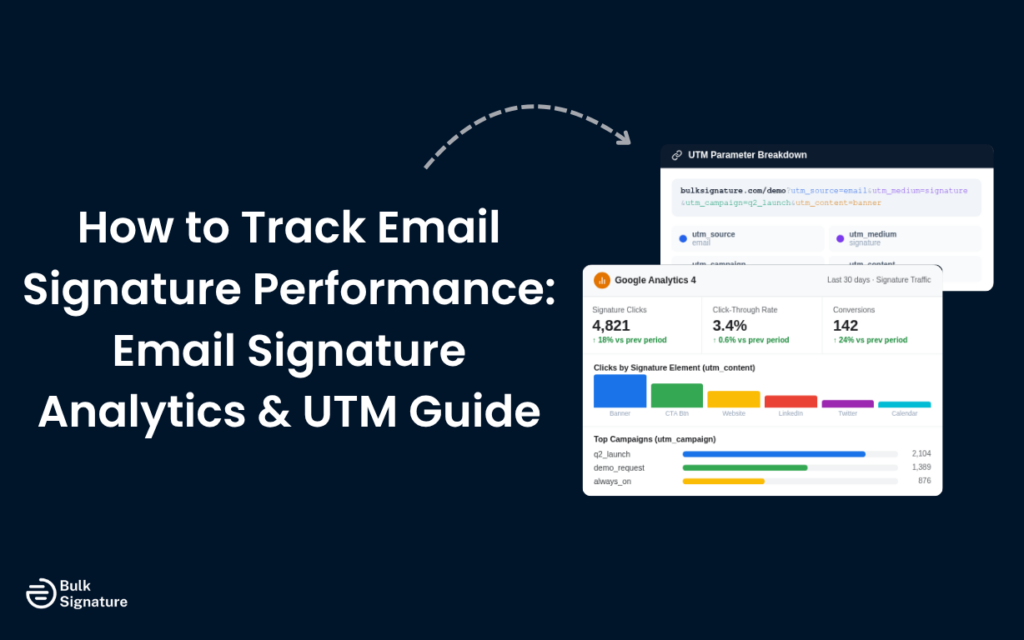
Most organizations have no idea. So in this article, we’re covering how to use UTM parameters and helpful email signature analytics tools to track email signature performance. We’ll also share some insights into what metrics to focus on and how to use that valuable data to make better decisions about your marketing and communication strategy.
Why Email Signature Performance Tracking Matters for Your Marketing Strategy
Before we get into setup, it helps to understand how email signature analytics fit into your broader digital marketing efforts and why they deserve attention alongside your other channels.
Data Collection: Turning Every Email Into Measurable Activity
An email signature typically includes multiple clickable elements, such as your website link, social media icons, a call to action button, a promotional banner, or a link to a landing page. Each interaction with those elements contributes to your signature tracking clicks data.
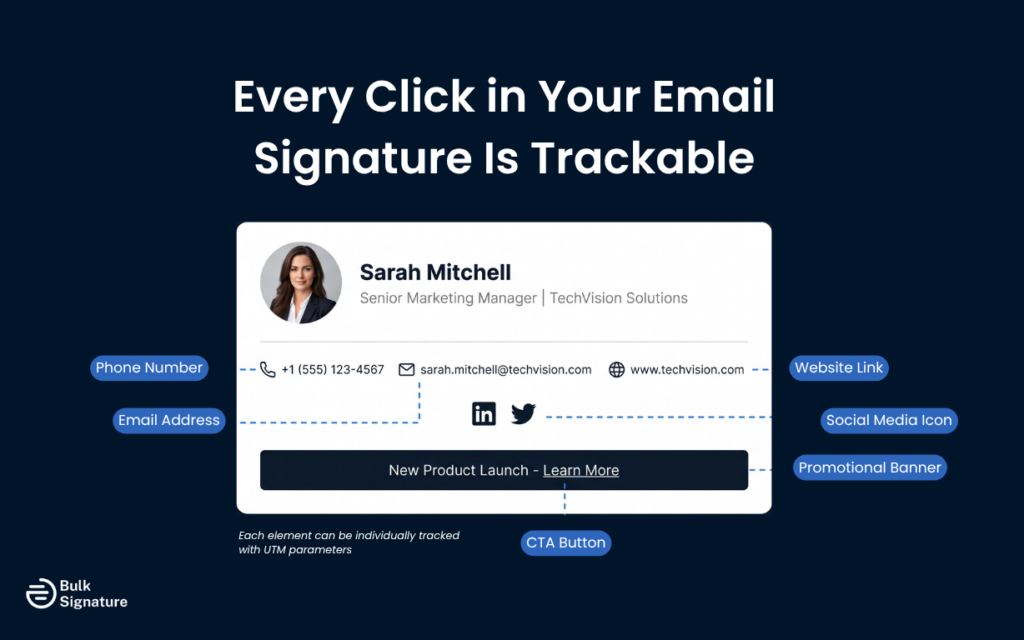
Without structured tracking, those interactions are invisible. You don’t know which links are being used, how often they’re clicked, or what happens after the click. That creates a gap in your overall data collection, especially given how frequently email signatures are exposed across your organization.
With proper tracking in place, every click becomes a measurable data point. Over time, this builds a reliable dataset that shows how recipients engage with your signature across different contexts, like sales emails, support replies, and day-to-day communication.
Optimizing Marketing Messages: Understanding What Actually Gets Attention
Think of your email signature as a distribution channel, and any banners, CTAs, and featured links are all part of how you promote your content and campaigns.
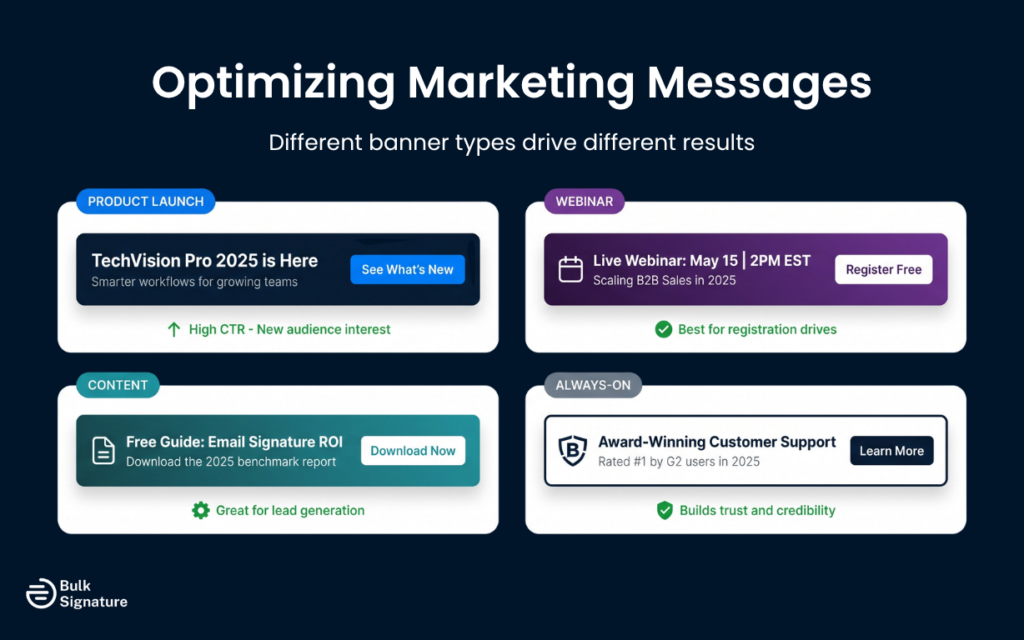
By tracking individual interactions, you can better understand what messages are resonating. You can compare performance across different designs and campaigns, refine your messaging, adjust placement, and prioritize the elements that generate the most engagement.
Tracking Conversions: Connecting Clicks to Business Outcomes
Clicks are useful, but they only tell part of the story. The real value comes from understanding what happens after someone interacts with your signature.
This is where conversion tracking becomes essential. By linking signature tracking clicks to actions like form submissions, demo bookings, or content downloads, you can measure the actual impact of your email signature on business outcomes. For an SaaS company, that might mean tracking newsletter sign-ups driven by a signature CTA. For a professional services firm, it could mean measuring visits to a case study or booking page.
The exact metrics vary, but the principle is consistent: your email signature is generating activity that can be tied back to revenue, pipeline, or engagement goals. And with the right tracking in place, it becomes part of a measurable, accountable marketing system rather than an unmonitored add-on.
More on tracking clicks, impressions, and conversions here: How to Track Clicks and Impressions in Email Signature Marketing
Understanding UTM Parameters
UTM stands for Urchin Tracking Module, which is a naming convention inherited from Urchin Software, which Google acquired in 2005 to build what became Google Analytics. Despite the technical-sounding name, UTM parameters are super straightforward to use.
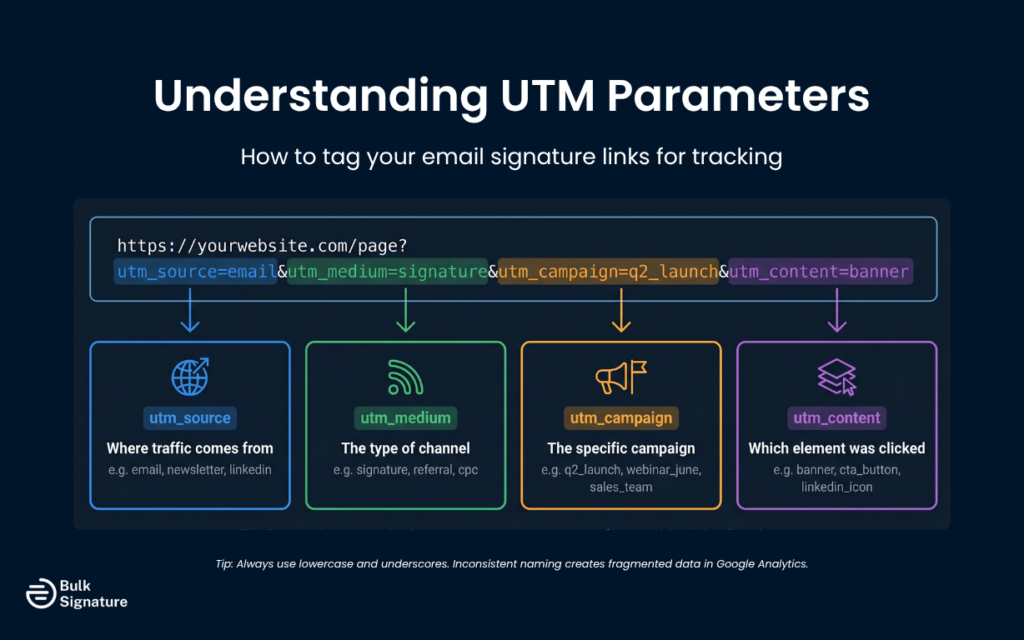
A UTM parameter is a tag added to the end of a URL that tells your analytics platform where a click came from. When someone clicks a UTM-tagged link in your email signature and lands on your website, Google Analytics (or whichever analytics platform you use) records the source, medium, and campaign associated with that click.
A basic UTM link looks like this: https://yourwebsite.com/page?utm_source=email&utm_medium=signature&utm_campaign=q2_campaign
The three core parameters are:
- utm_source – where the traffic is coming from (such as email or newsletter)
- utm_medium – the type of channel (such as signature or referral)
- utm_campaign – the specific campaign or context (such as q2_launch or sales_team or webinar_june)
Two optional parameters add more detail:
- utm_content – useful for comparing performance between different signature elements (such as a banner vs cta_button)
- utm_term – traditionally used for identifying paid search keywords, but can be used to capture additional detail such as audience segments or internal classifications
The key to accurate attribution is consistency. If some links use utm_source=email and others use utm_source=Email, Google Analytics treats them as two separate sources. Always define your naming conventions before you start and stick to them.
To help you apply these parameters consistently across your signature links, here’s a practical example of how UTM values can be structured for different elements.
Signature UTM Tracking: Example UTM Structure for Email Signature Elements
Signature Element | utm_source | utm_medium | utm_campaign | utm_content |
Website URL | signature | always_on | website_link | |
Promotional banner | signature | q2_product_launch | banner | |
CTA button | signature | demo_request | cta_button | |
Social media icon (LinkedIn) | signature | always_on | linkedin_icon | |
Event registration link | signature | webinar_june | event_cta |
How to Add UTM Parameters to Your Email Signature Links
The process for adding UTM parameters to signature links is the same regardless of which email client or signature management tool you use. Here’s the general approach.
Step 1: Identify the Links in Your Signature
List every clickable element in your email signature, such as your website URL, social links, CTA buttons, signature banners, and any other links. Each one can have its own UTM parameters, which lets you track clicks on each element separately.
Step 2: Build Your UTM Links
Google’s Campaign URL Builder is a free tool that generates UTM links without any manual URL editing. All you have to do is enter your destination URL and fill in the parameter fields, and it generates the complete tracking link for you.
Step 3: Replace Your Existing Links With UTM-Tagged Versions
In your email signature editor or email signature management platform, swap out the plain URLs for the UTM-tagged versions. If you’re using a centralized signature management tool like BulkSignature, you can update the links across your entire organization at once rather than asking each employee to update their own signature.
Step 4: Test the Links
Click each link yourself and check that the correct source, medium, and campaign data appear in your analytics platform. This is worth doing before rolling out to your full team (you’d be surprised at how easy it is for small errors to creep in!).
Key Metrics to Track for Email Signature Campaign Performance
Once your UTM links are in place and data starts flowing into your analytics platform, these metrics provide a clear view of how your email signature marketing campaigns are performing and where to optimize.
Core Email Signature Performance Metrics
Metric | What It Measures | Why It Matters | How to Track It |
Click-through rate (CTR) | Percentage of recipients who clicked a signature link | Indicates overall engagement with your signature | Compare signature tracking clicks in Google Analytics with email send volume from your email service provider |
Link clicks by element | Clicks on individual signature components (banner, CTA, social icons, etc.) | Shows which elements attract attention and which can be deprioritized | Use utm_content to differentiate elements and analyze in GA4 |
Conversion rate | Percentage of clicks that lead to a desired action (such as demo booking or sign-up) | Connects signature activity to real business outcomes | Set up goals or events in GA4 to track post-click actions |
Campaign performance | Performance comparison across different signature campaigns | Helps evaluate which campaigns drive the most engagement and conversions | Filter by utm_campaign in GA4 |
Traffic by team or segment | Traffic generated by different departments or user groups | Identifies which teams drive the most user engagement | Use distinct utm_campaign values (such as sales_team vs support_team) |
Setting Up Tracking in Google Analytics
With your UTM structure and key metrics defined, the next step is making that data visible inside your analytics platform.
Google Analytics 4 (GA4) is the current standard for web analytics, and it handles UTM parameters automatically. So when someone clicks a UTM-tagged link and lands on your website, GA4 records the session and attributes it to the source, medium, and campaign you specified.
Here’s how you can view your email signature performance data in GA4:
- Go to Reports > Acquisition > Traffic acquisition
- Filter by Session medium = “signature” (or whatever value you used for utm_medium)
- Review sessions, engagement rate, and conversions attributed to signature traffic
For more detailed analytics, you can create a custom exploration in GA4 that breaks down signature traffic by campaign, content parameter, or landing page. This gives you detailed insights into which signature elements are driving the most valuable traffic.
If your organization uses other marketing tools alongside Google Analytics (such as a CRM, a marketing automation platform, or a dedicated analytics tool), UTM data flows through to those systems as well, provided your website passes the parameters correctly. This lets you centralize data across your marketing channels and get a complete picture of how your signature campaigns contribute to overall marketing performance.
Best Practices for Email Signature Analytics
Getting the technical setup right is only part of the picture. The following five best practices help you get more accurate and actionable data from your tracking efforts.
1. Use Consistent Naming Conventions
As noted above, inconsistent UTM values create fragmented data. Document your naming conventions in a shared place everyone can access, and make sure anyone creating signature links follows the same format.
2. Differentiate Between Teams and Campaigns
If your sales team and support team use different signatures, give them different campaign values. This lets you compare performance across segments and identify which teams’ signatures are driving the most engagement data.
3. Update UTM Links When Campaigns Change
When you swap out a signature banner for a new campaign, update the UTM parameters to reflect the new campaign name. Leaving old UTM values in place means your new campaign’s performance gets mixed in with historical data, making it harder to measure campaign effectiveness accurately.
In practice, updating links across an entire organization can be time-consuming without centralized control. With BulkSignature, campaign links and UTM parameters can be updated across all users at once, making it easier to keep tracking aligned with active campaigns.
Learn more about how BulkSignature empowers teams to manage email signatures at scale in our campaign management hub.
4. Track Signature Banners Separately from Static Links
Your website URL and social links are always-on elements. Your promotional banners change with campaigns. Treating them as separate tracking categories (using utm_content to differentiate) gives you cleaner data for comparing performance.
5. Review Performance Regularly
Email signature analytics are most useful when reviewed on a consistent schedule. A monthly review of click-through rates and conversion data lets you identify trends, spot underperforming elements, and make adjustments before a campaign ends.
Putting Your Email Signature Data to Work With BulkSignature
Tracking email signature performance is only valuable if it leads to better decisions. Once you have reliable data flowing through your UTM parameters and analytics platform, it’s up to you to interpret that data and apply it to your signature strategy.

If you’re managing email signatures at scale, this is where centralized management becomes essential. With tools like BulkSignature, you can manage signatures, update tracking links, and roll out campaigns across your entire organization from a single place, keeping both your branding and your data consistent.
Ready to launch (and track) your first banner campaign? Try BulkSignature for free today!
Want to see how a tool like BulkSignature can improve your bottom line, too? Read this: The ROI of Centralized Email Signature Management (With Calculator)
Frequently Asked Questions About Email Signature Analytics
How can I track email signature performance effectively?
To track email signature performance, you need to add UTM parameters to every link in your signature. This allows tools like Google Analytics to capture data on where clicks come from, how users interact with your links, and which campaigns drive engagement. Over time, this helps you measure engagement and understand how your signature contributes to traffic and conversions.
What are email signature analytics, and why do they matter?
Email signature analytics refer to the data collected from interactions with links in your signature. This includes signature tracking clicks, traffic sources, and conversions. These insights help you track performance, evaluate campaigns, and make informed decisions about your signature design and messaging.
How do I measure engagement in my email signature?
You can measure engagement by looking at metrics like click-through rate (CTR), total link clicks, and clicks by individual signature elements. These metrics show exactly how many people interact with your signature and which parts generate the most attention.
Can email signatures really drive traffic to my website?
Yes. Because email signatures appear in every outbound message, they can consistently drive traffic to your website, landing pages, or campaigns. With proper tracking in place, you can see how much traffic is generated and which links perform best.
What should I track in email signature campaigns?
To effectively track email signature campaigns, focus on a core set of performance metrics that show both engagement and business impact. Start with click-through rate (CTR) to understand how often recipients interact with your signature links. From there, look at signature tracking clicks by element to see which parts (such as banners, CTAs, or social icons) are attracting the most attention.
It’s also important to monitor conversion rate, which shows how many of those clicks lead to meaningful actions like sign-ups or demo requests.
Together, these metrics provide valuable insights into what’s working and where to optimize.
How can I compare different email signature designs?
By using the “utm_content” parameter, you can assign unique identifiers to different elements or designs (such as banner vs CTA button). This allows you to compare how different signature designs perform and identify which layout drives more engagement.
How do I know exactly how many people clicked my email signature links?
Tools like Google Analytics allow you to track the number of clicks on UTM-tagged links. While email clients don’t directly report this, combining analytics data with your email send volume gives you a clear picture of how many people are interacting with your email signature.


