

You’ve written the perfect email, but you find yourself stuck on the final line.
Do you go with… Best regards? Thanks? Sincerely?
It feels like you’re overthinking it (and maybe you are a bit). But actually, that last line of your email is a lot more important than most people realize.
Why? Because in competitive industries where first impressions and emotional intelligence are everything, even a two-word closing can influence how your message is received.
So to help you choose the right email sign-off every time, we’re breaking down all the different universally accepted ways to sign off an email across industries, contexts, and levels of formality. So you’ll never second-guess the closing sign-off in your email ever again.
But first…
Why Do Sign-Offs Even Matter in Email Communication?
It’s tempting to treat your sign-off as an afterthought. You’ve already written your message and made your point, so why should it matter?
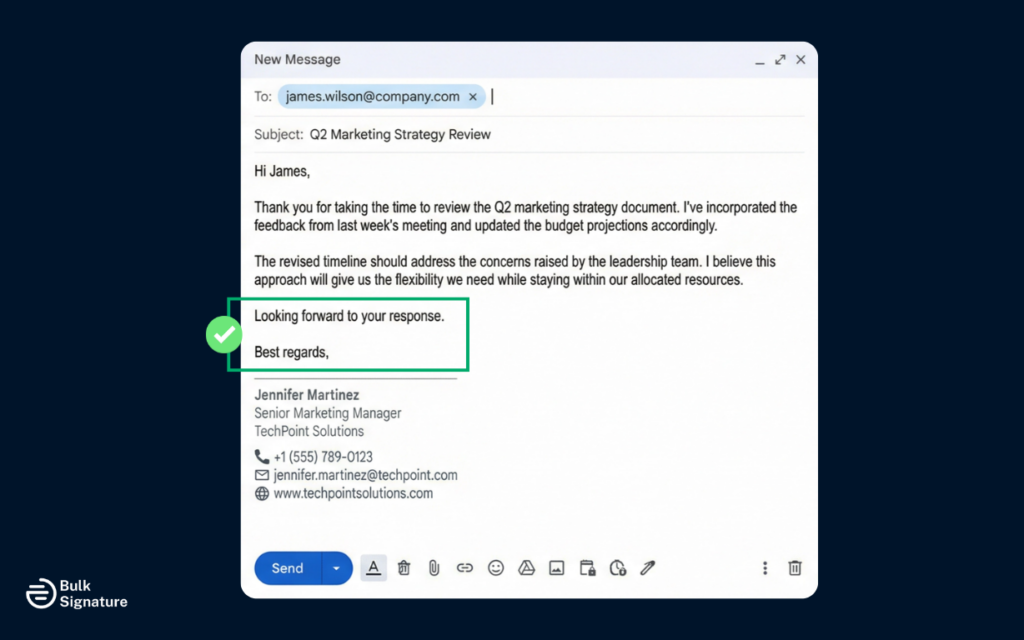
It matters because your closing line is the final emotional cue your reader receives. It’s the last impression you leave, and last impressions tend to stick.
A thoughtful sign-off does three important things:
- Reinforces your professional tone. It confirms whether you’re confident, respectful, collaborative, or appreciative. A mismatch between your message and your email closing can feel off.
- Signals your relationship. “Best regards” feels professional. “Thanks” feels familiar. “Respectfully” signals deference. Those small choices define how you position yourself.
- Sets expectations. A closing like “Looking forward to your response” subtly communicates that a reply is expected.
It may only be a few words, but those words ultimately shape perception.
Professional Email Sign-Offs for Formal Business Contexts
When you’re communicating in a formal business setting, your email sign-off should reflect the right level of professionalism and respect.
The following closings are widely accepted in business correspondence and tend to work well in most professional situations.
Formal Business Email Sign-Offs
Sign-Off | Level of Formality | Best Used For | Tone & Notes |
Best Regards | Professional (Moderate) | Initial emails, follow-ups, ongoing business communication | Widely accepted and versatile. Formal without sounding stiff. A safe choice if you’re not sure about tone. |
Kind Regards | Professional (Moderate–Warm) | Ongoing communication, established rapport | Similar to “Best Regards” but slightly warmer. Maintains professionalism while also adding a warm, personal touch. |
Sincerely | Formal | Job applications, senior executives, law firms | Classic and traditional. Best for highly professional contexts, and can feel overly formal in more casual settings. |
Sincerely Yours | Very Formal | Cover letters, formal requests, government officials | More formal than “Sincerely.” Reserved for high-level or traditional correspondence. |
Respectfully | Formal | Authority figures, legal/government/academic contexts | Conveys seriousness. Appropriate when addressing someone in a position of authority. |
Respectfully Yours | Very Formal | Military correspondence, high-ranking officials | Extremely formal. Used in structured or hierarchical environments. |
Thank You | Professional (Courteous) | Expressing gratitude, requests, general business emails | Polite and versatile. Adds appreciation and professionalism to most communications. |
Thanks in Advance | Professional (Request-Based) | When making a request | Shows appreciation ahead of time. Use carefully, as it may sound presumptuous if overused. |
Casual Email Sign-Offs (That Are Still Professional)
Not every email needs to sound like it’s headed to a board of directors.
Once you’ve built a relationship (for example, with a colleague, a long-term client, or a trusted partner), your tone can naturally become more relaxed.
These closings work well when you:
- Communicate regularly with the recipient.
- Have established rapport.
- Want to sound collaborative and human.
- Are writing in creative or less traditional industries.
Below are informal email sign-offs that still protect your credibility while making your communication feel natural and authentic.
Casual (But Still Professional) Email Sign-Offs
Sign-Off | Level of Formality | Best Used For | Tone & Notes |
Warm Regards | Professional (Warm) | Established client relationships, follow-up emails, ongoing business communication | Balances professionalism with friendliness. Warmer than “Best Regards” without becoming casual. |
Warm Wishes | Professional (Friendly) | Holiday messages, goodwill outreach | Friendly and positive. Works well when expressing seasonal or personal goodwill. |
All the Best | Professional (Casual-Moderate) | Creative industries, close colleagues | Upbeat and approachable. Less formal than “Best Regards” but suitable for many business contexts. |
Best | Professional (Casual) | Quick emails, internal communication | Short and efficient. Works well with colleagues you know well. May feel too casual for first-time or highly formal communication. |
Looking Forward to Hearing From You | Professional (Response-Oriented) | When expecting a reply or encouraging follow-up | Shows engagement and interest in the recipient’s response. Longer than typical closings, so best used when it fits naturally. |
Cheers | Casual Professional | Informal communication, British English contexts | Friendly and upbeat. Appropriate for colleagues you know well. Not ideal for formal or first-time business communication. |
Thanks | Casual Professional | Quick notes, expressing appreciation | Simple and appreciative. More relaxed than “Thank You” but suitable in many workplace contexts. |
Talk Soon | Casual | Ongoing conversations with familiar colleagues | Friendly and conversational. Appropriate when you expect future communication soon. |
Take Care | Casual (Warm) | Close colleagues, supportive messages | Adds a personal touch and conveys care. Too personal for formal or first-time business emails. |
Have a Great Day | Casual Professional | Positive everyday workplace emails | Upbeat and friendly. Appropriate for casual professional settings but not for formal correspondence. |
Email Sign-Offs to Avoid
As long as you have a firm grasp of the basics, there’s no need to overthink every email. However, there are a few closings that are best avoided in virtually all professional communications.
Overly Casual or Funny Email Sign-Offs
While humor can be appropriate in some contexts, overly casual or funny email sign-offs like “Stay awesome,” “Peace out,” or “Later” are generally too informal for professional emails. Save these for personal emails or very casual work environments where they’re accepted.
Passive Aggressive Sign-Offs
Sign-offs like “As per my last email” or “Per my previous message” can come across as passive-aggressive, even if that’s not your intention. If you need to reference a previous email, do so in the body of your message, not in your closing.
Overly Emotional Sign-Offs
While warmth is good, overly emotional sign-offs can be inappropriate in professional contexts. For example, phrases like “With love” or “Hugs” should be reserved for personal emails, not business correspondence.
Vague or Confusing Closings
Closings that are vague, overly creative, or unclear can feel awkward in a professional setting. Your final line should feel intentional and easy to interpret. When in doubt, clarity wins. A simple, straightforward closing almost always lands better than something clever but confusing.
Inspirational Quotes
Adding a motivational quote to your email signature might feel thoughtful or expressive. But in many business contexts, it can come across as distracting, overly personal, or even preachy.
There are exceptions. If a quote is genuinely part of your professional brand or company culture, it may fit naturally. But in most industries, especially corporate or client-facing environments, it’s better to keep your email focused, concise, and professional, and leave the inspirational content for social media or internal team channels.
Best Practices for Email Sign-Offs
Choosing the right words matters, but how you use them matters just as much. Here are a few practical guidelines to bear in mind when writing your email sign off.
Capitalize Only the First Word
Yes, it’s a small detail. But it’s still important. In professional emails, only the first word of your closing phrase should be capitalized.
For example: Write “Best regards,” not “Best Regards.”
This is the standard convention in business communication, and sticking to it keeps your email looking as polished as possible.
Match Your Sign Off to Your Email’s Tone
Your closing should feel like a natural extension of your message.
If your email is formal and structured, your sign-off should reflect that. If your tone is friendly and conversational, a warmer, more casual closing makes sense. When the tone and sign off don’t align, the disconnect is noticeable, even if the reader can’t quite explain why.
Include Your Email Signature
After your sign off, always include a professional email signature with your contact details, job title, and any other relevant information.
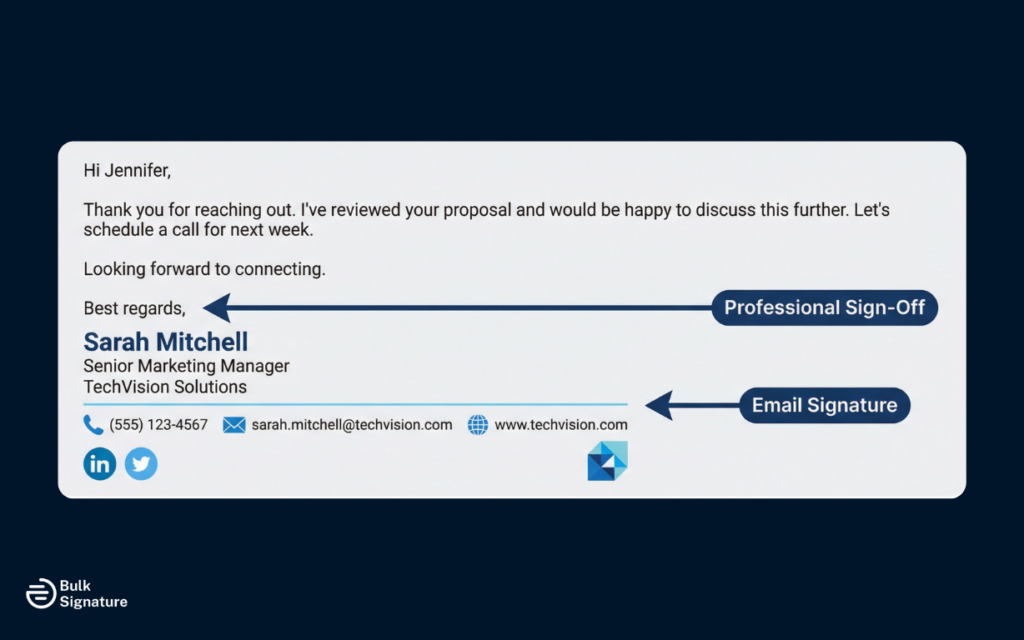
A well-designed email signature reinforces your professional image and makes it easy for recipients to contact you.
More on email signature design here:
- How to Design Email Signatures That Stand Out
- How to Design Your Email Signature in 2026
- Email Signature Design Trends To Watch In 2026
Proofread Your Closing
It’s easy to focus on the body of the email and forget the last line. But a spelling mistake or grammatical error in your sign-off will stand out like a sore thumb, especially since it’s so short. That’s why it’s important to give your sign-off the same quick proofread you give the rest of your message.
Consider Cultural Differences
Professional communication norms can vary depending on regions and industries. A sign-off that feels warm and appropriate in one country might feel too informal (or too stiff) in another.
If you’re communicating internationally, take a moment to consider expectations around tone, hierarchy, and communication style. That awareness will save you from awkward moments and accidental misunderstandings.
Add a Call to Action When Appropriate
Sometimes, your email requires a response or a next step. If that’s the case, make it clear before your sign off. A simple, direct sentence can remove guesswork and speed up replies.
For example, a polite statement like:
- “It would be great if we could have your feedback by Friday. Thanks and best regards,”
That one line tells the recipient exactly what you need and when you need it.
Clear calls to action reduce back-and-forth, prevent delays, and make you look organized. And when placed right before your closing, they feel natural (not pushy).
Make Every Sign Off Count With BulkSignature
No matter the industry, that final line in your email speaks volumes about your professionalism and attention to detail. So the next time you’re about to hit send, pause for a second to make sure your sign-off reflects your message (and the positive impression) you want to leave.
If you’re serious about maintaining a high level of professionalism and consistency across your organization, your professional email signatures and sign-offs shouldn’t be left to individual preference.
With tools like BulkSignature, you can centralize and manage company-wide signatures across Gmail and Microsoft 365, so every sign-off reflects your brand standards automatically. No inconsistencies, no outdated contact details, and no awkward formatting.
Ready to elevate every email your team sends? Book a free demo with BulkSignature today!
Frequently Asked Questions About Professional Email Sign-Offs
What are some good email sign-offs for everyday work communication?
You can never go wrong with the following professional email sign-offs:
- Best regards
- Kind regards
- Thank you
- All the best
These closings are universally understood and accepted as a professional way to sign off an email.
What are friendly sign-offs that are still professional?
If you want to add a bit of warmth without sounding overly casual, consider the following professional but friendly sign-offs:
- Warm regards
- Kind regards
- Thanks
- Have a great day
These sign-offs work well with colleagues, long-term clients, and ongoing conversations where you’ve already built rapport.
What are appropriate holiday email sign-offs?
Professional holiday email sign-offs depend on your audience and company culture. Common options include:
- Happy holidays
- Season’s greetings
- Warm wishes
- Best wishes
- Merry Christmas
What are appropriate condolence email sign-offs?
Condolences email sign-offs should be sincere and understated. Appropriate options include:
- With sympathy
- Thinking of you
- My deepest condolences
- With heartfelt sympathy


